Čeština
  Deutsch
  Español
  Français
  Italiano
  Magyar
  Nederlands
  Polski
  Português
  Slovenčina
  Türkçe
  Русский
  中文
中文  한국의
한국의 KOBOLD Instruments Inc • 1801 Parkway View Drive • 15205 Pittsburgh, PA • Tel: +1 412 788 2830 • E-mail: Please activate JavaScript • visit koboldusa.com

 Vibrating Level Monitoring

Frequently Asked Questions Vibratingt Level Switches
What is a Vibrating Level Switch?
A vibrating level switch is a point-level detection device used to monitor the presence or absence of liquids or bulk solids in tanks, vessels, or pipelines. It uses a vibrating probe, typically a tuning fork, to detect level changes and provide a reliable switching output for process control applications. These switches are widely used in industries where consistent performance, durability, and minimal maintenance are required.
How does a Vibrating Level Switch work?
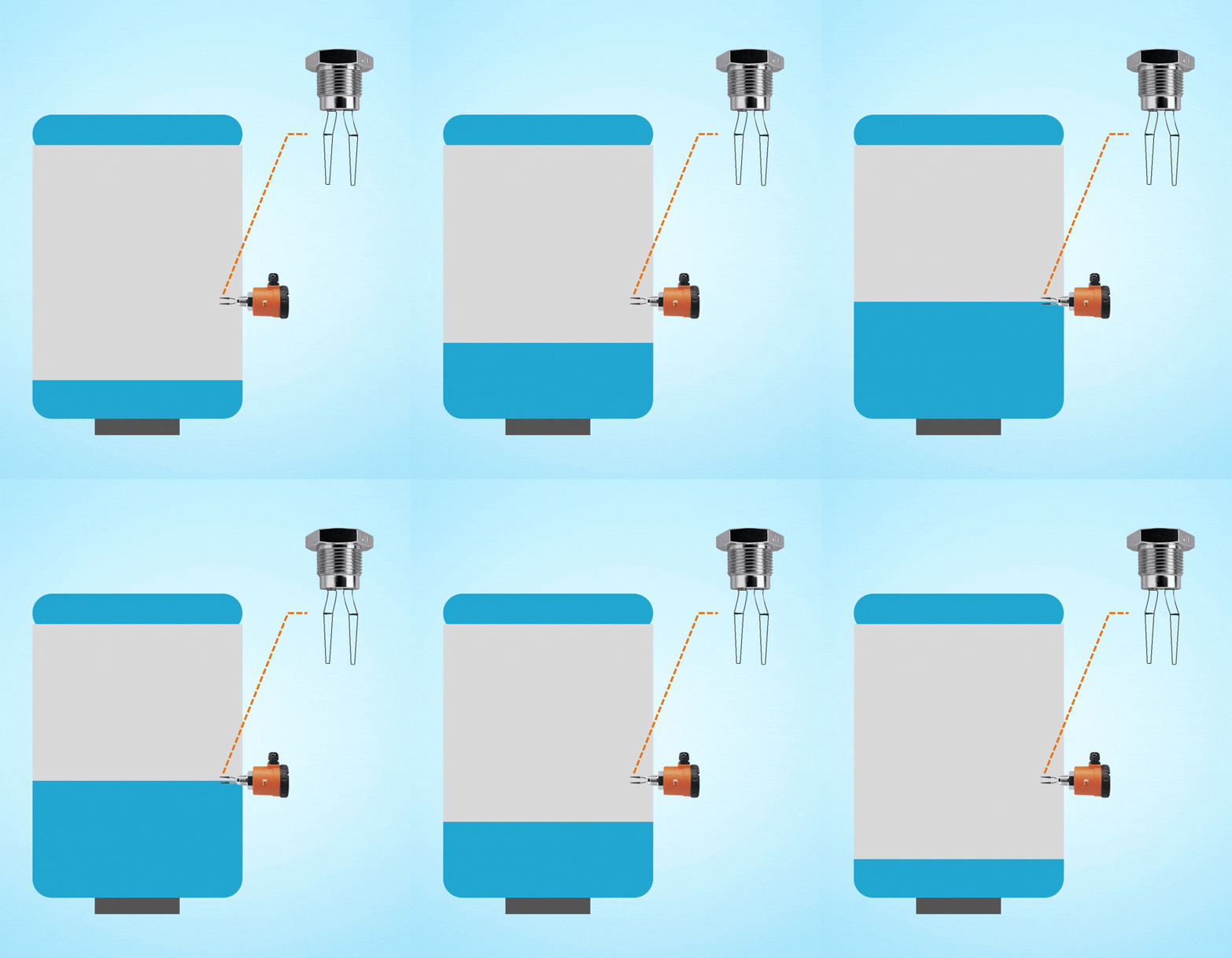
A vibrating level switch operates using a probe that vibrates at a fixed resonance frequency generated by a piezoelectric element. When the probe comes into contact with the medium, the vibration is damped, causing a change in frequency. This change is detected by the electronics and converted into a switching signal, which can be used to control alarms, pumps, or other systems for level monitoring.
These switches are designed for easy installation and integration, with options such as adjustable sensitivity, switching delay, and fail-safe (minimum or maximum level) operation. Some variants also offer extended probe lengths, modular electronics for easy maintenance, and suitability for hazardous environments.
What types of media can a vibrating level switch measure?
Vibrating level switches are suitable for detecting a wide range of media, including both liquids and bulk solids. They can be used with standard liquids such as water, as well as viscous liquids like oils, sauces, and paints. These switches are also effective in handling challenging media such as foaming liquids, milk, and liquids containing gases like carbon dioxide.
In addition to liquids, vibrating level switches are widely used for bulk solids such as grain, cement, flour, sugar, plastic granules, and animal feed. Their versatility makes them suitable for diverse materials without being affected by properties like conductivity or density variations.
In which applications are vibrating level switches used?
Vibrating level switches are widely used for reliable point-level detection across various industries. Key applications include.
- Overflow Protection: It Prevents tanks and vessels from overfilling by triggering a switch at a defined level.
- Dry-Run Protection: It Protects pumps by detecting low levels and stopping operation to avoid damage.
- Level Monitoring in Tanks & Pipelines: Ensures proper control of liquid or solid levels in storage and process systems.
- Liquid Applications: It is Suitable for water, oils, viscous liquids, sauces, milk, paints, and liquids containing gases (e.g., carbon dioxide).
- Bulk Solid Applications: It is Used for materials such as grain, cement, flour, sugar, plastic granules, and animal feed.
- Petroleum Industry: Vibrating level switches are used to monitor fuel levels in storage tanks and pipelines, ensuring safe handling and preventing overflow or dry-run conditions in oil-related operations.
- Chemical Industry: These switches are widely used for handling aggressive and hazardous chemicals, providing reliable level detection even in challenging process conditions.
- Water & Wastewater Industry: They are used for level control in water treatment plants, sewage systems, and storage tanks, helping maintain efficient flow management and preventing system failures.
- Food & Beverage Industry: Vibrating level switches are suitable for hygienic applications such as monitoring liquids like milk, sauces, and beverages, as well as bulk materials like sugar and flour.
- Pharmaceutical Industry: These switches are used in processes requiring high precision and cleanliness, ensuring accurate level monitoring of sensitive liquids and materials.
- Plastics Industry: Suitable for powders and granular materials used in plastic processing and manufacturing.
- Paper Industry: Used for materials such as cellulose and wood chips in paper production processes.
- Recycling Industry: Effective for monitoring plastic granules and paper shavings in recycling operations.
- Power Plants: Used for handling materials like flue dust, lime, and coal in energy generation processes.
- Building & Construction Industry: Ideal for materials such as cement, sand, lime, and stone powder used in construction applications
What are the key features of a vibrating level switch?
Vibrating level switches are designed to deliver reliable and stable level detection in demanding industrial environments. Key features include
- Visual Status Indication: Some models are equipped with a LED indicator that provides real-time visual confirmation of the switching status, helping users easily monitor device operation.
- Configurable Switching Modes: The device can be set for either upper (overflow) or lower (dry-run) level detection, offering flexibility for different applications.
- Robust and Durable Design: Built for industrial use, vibrating level switches are designed to withstand harsh process conditions and ensure long-term reliability.
- Stable Measurement Performance: Their operation is largely unaffected by external factors such as flow, bubbles, vibrations, material build-up, or solids in the medium.
- Low Maintenance Requirements: With no moving parts exposed to wear, these switches require minimal maintenance, reducing operational costs.
- Safety and Hazardous Area Suitability: Certain variants are available with explosion-protected designs, making them suitable for use in hazardous environments.
What is a Tuning Fork Level Switch?
A tuning fork level switch is a type of point level sensor used to detect the presence or absence of liquids and bulk solids in tanks, vessels, or pipelines. It operates on the principle of a vibrating fork, which is driven by a piezoelectric (ceramic) crystal located inside the fork assembly.
When the fork is in air, it vibrates at its natural resonance frequency, which is continuously monitored by the internal electronic circuitry. When the fork comes into contact with a medium such as a liquid or solid, the vibration is damped, causing a change in frequency.
This change is detected by the electronics and converted into a switching signal, typically provided as a relay output (Normally Open or Normally Closed). The output signal indicates whether the level is high or low, depending on the application setup.
Tuning fork level switches are widely used for point level detection in both liquids and solids, helping to identify when a material reaches a specific level for process control and safety.
What are the advantages of vibrating level switches?
Vibrating level switches offer several advantages for reliable point-level detection.
- Versatile Application: Suitable for liquids, powders, and bulk solids across various industries.
- Easy Installation & Setup: Simple to install and can be commissioned without complex calibration.
- Reliable Performance: Provides accurate level detection and is largely unaffected by installation position, pressure, temperature, foam, or flow conditions.
- Low Maintenance: Minimal maintenance is required due to the absence of exposed moving parts and reduced risk of coating or buildup.
- Compact Design: Ideal for use in tanks, vessels, and pipelines where space is limited.
- Stable Operation: Ensures consistent performance even in challenging process environments.
What are the disadvantages of vibrating level switches?
Despite their benefits, vibrating level switches have certain limitations.
Key benefits include:
- Sensitive to Material Properties: Performance can be affected by factors such as density and viscosity of the medium.
- Not Ideal for Highly Viscous Media: Sticky or viscous materials may accumulate on the fork, affecting accuracy.
- Limited Use in Highly Agitated Conditions: Excessive turbulence or vibration in the medium may impact measurement reliability.
- Possible Calibration Requirement: Some applications may require periodic calibration to maintain accuracy.
What types of vibrating level switch models are available?
Vibrating level switches are available in different models designed to suit specific applications involving liquids and bulk materials.
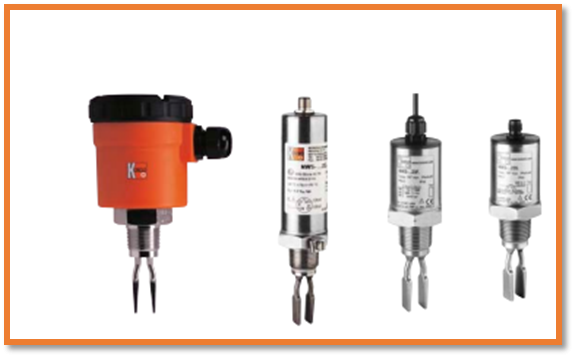
- Tuning Fork Level Switch for Liquids (NWS Type): Suitable for use in vessels and pipelines, this type operates on the tuning fork principle and provides reliable level detection without moving parts. It is designed for stable performance and is insensitive to plant vibrations. To know more about the product specifications, click here.
- Vibrating Level Switch for Bulk Solids (NSV Type): Designed for bulk materials, including low-density solids, this model offers reliable detection with a robust stainless-steel fork and easy maintenance. It is ideal for applications where consistent performance and simple installation are required. To know more about the product specifications, click here.
- Vibrating Level Switch for Bulk Materials (NVI Type): This model uses a vibrating probe system to detect level changes in bulk materials. It provides dependable switching signals and is suitable for general solid level detection applications. To know more about the product specifications, click here
The selection of the appropriate model depends on the type of medium, installation conditions, and application requirements. Need help choosing the right model? Contact our engineer.
What are the pressure and temperature limits of vibrating level switches?
The pressure and temperature limits of vibrating level switches depend on the material and design of the device. Typically, these switches can operate under a range of conditions to suit different industrial applications.
- Some variants are designed for high-pressure applications and can withstand pressures up to 45 bar, with operating temperatures up to 130°C and up to 150°C during CIP (clean-in-place) cleaning processes.
- Other variants are suitable for moderate conditions, supporting pressures up to 25 bar and temperatures up to 160°C. For simpler or non-pressurized applications, certain models are designed for pressure less environments and can operate at temperatures up to 80°C.
It is important to select the appropriate specification based on the process requirements to ensure safe, accurate, and long-term operation.
How should a Vibrating Level Switch be correctly installed?
A vibrating level switch (tuning fork type) must be installed correctly to ensure accurate level detection and to prevent false triggering. Following standard installation practices is essential for reliable performance.
Correct Installation (Recommended):
- Install the switch vertically from the top of the tank for optimal performance.
- Ensure that the fork is fully exposed to the material and not obstructed by any internal structures.
- Maintain adequate clearance from tank walls, agitators, and inlet streams to avoid interference.
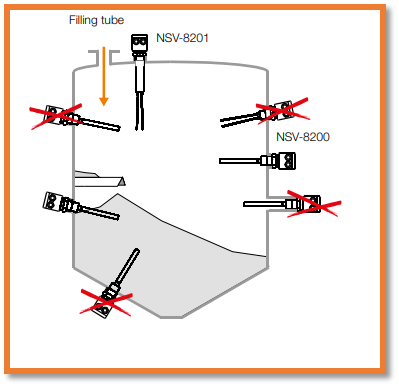
Incorrect Installations (Avoid These):
- Avoid horizontal mounting directly in the material flow path, as this may cause false vibration signals.
- Do not install near filling inlets or discharge zones, where turbulence or falling material can trigger false alarms.
- Avoid placing the sensor too close to tank walls or corners, as this can lead to material buildup and inaccurate readings.
- Do not install the switch at a downward angle near the bottom, as this increases the risk of sediment accumulation on the fork.
Best Practices:
- Install the device away from areas with high vibration or turbulence.
- Avoid locations where material buildup or bridging is likely to occur.
- For solid materials, ensure the fork is positioned where free and consistent material flow is present.
- Always follow the manufacturer’s guidelines for minimum distance from walls and surrounding obstructions.
Proper installation ensures stable vibration frequency, accurate level detection, and a longer service life of the sensor. To know more about it Speak with our technical expert.
What materials are used in vibrating level switches?
Vibrating level switches are commonly manufactured using different grades of stainless steel to suit various industrial applications. Materials such as stainless steel 1.4404 are widely used for hygienic and corrosion-resistant environments, while stainless steel 1.4305 (AISI 303) is suitable for general-purpose and low-demand applications. Stainless steel 1.4571 is often selected for its enhanced resistance to higher temperatures and more demanding process conditions.
The choice of material depends on the operating environment, type of medium, and required durability to ensure reliable and long-lasting performance.
Are vibrating level switches available with hazardous area certifications?
Yes, vibrating level switches are available with hazardous area certifications such as ATEX and IECEx, making them suitable for use in environments where explosive gases, vapors, or dust may be present. These certifications ensure that the devices meet strict safety standards for operation in potentially hazardous conditions.
Certification availability may vary depending on the model and application requirements. For detailed specifications and guidance on selecting the right certified device, it is recommended to consult with our experts.
What maintenance is required for vibrating level switches?
Vibrating level switches are designed for stable and reliable operation over long periods and typically do not require regular maintenance or recalibration. Their robust design ensures consistent performance without the need for routine adjustments.
However, if any malfunction or abnormal behaviour is observed, the device should be removed from service immediately. As these devices do not contain user-serviceable parts, inspection and repair should only be carried out by the manufacturer or authorized personnel.
To know more about level monitoring solutions, visit our website.
Other Members of the KOBOLD group