Čeština
  Deutsch
  Español
  Français
  Italiano
  Magyar
  Nederlands
  Polski
  Português
  Slovenčina
  Türkçe
  Русский
  中文
中文  한국의
한국의 KOBOLD Instruments Inc • 1801 Parkway View Drive • 15205 Pittsburgh, PA • Phone: +1 412-788-2830 • eMail: Please activate JavaScript • visit koboldusa.com

 Thermal Dispersion

Frequently Asked Questions: Thermal Dispersion
What is a Thermal Dispersion Mass Flow Meter?
A thermal dispersion mass flow meter (also known as a thermal mass flow meter) measures the mass flow rate of gases using the cooling effect of gas passing a heated element. This technology provides a direct mass flow measurement, without a need for pressure or temperature compensation to ensure an accurate gas flow reading.
How does a thermal mass flow meter work?
The working principle of thermal mass flow meters is based on L.V. King's Law (1914), which describes heat transfer in gas flows. The physical effect utilized is that a flowing medium (gas molecules) absorbs convective heat energy and carries it away.
Thermal mass flow meters operate by measuring how much a flowing gas cools a heated sensor. There are generally two variations. The first uses two temperature dependent resistance sensors (RTDs).One measures the actual gas temperature as reference, while the other is continuously heated electrically to maintain a defined temperature above the gas temperature. As gas flows across the heated sensor, it absorbs heat through convection. The faster the gas flows, the more heat is removed from the sensor.
The second variation uses a bypass system where a pressure differential (Δp) is generated between a laminar flow element and measuring tube section. Due to this Δp, a defined, reproducible partial gas flow enters the measuring tube section, where the sensor technology such as thermal RTD sensors is located. Two resistance measuring wires (RTD sensors) attached to the measuring tube are constantly heated. In the case of gas flow, a flow dependent temperature difference results from the cooling of the upstream sensor, which is linearly proportional to the mass flow of the gas.
Based on these two variations, thermal mass flow meters use two main measurement concepts:
1) Constant Temperature Difference (CTD): The meter measures and adjusts the electrical power required to maintain a constant temperature difference (ΔT) between the heated sensor and process gas. This power is directly proportional to the mass flow rate of the gas and the primary measurement signal. Higher mass flow means increases heat loss and cooling, requiring more power to keep ΔT constant.
Advantages:
- Fast response time due to active temperature control.
- High sensitivity for clean, dry gases.
- Preferred for precise, dynamic flow applications.
Disadvantages:
- Sensitive to contamination, moisture, and buildup on sensor, due to Rapid power corrections to maintain fixed ΔT . Condensation triggers unstable readings until averaging filters smooth the signal.
- Lower accuracy in dirty/wet gases due to probe fouling.
2) Constant Power (CP): The heating power supplied to the sensor remains constant, while the instrument measures the resulting temperature difference (ΔT) between the two sensors, which correlates inversely with the mass flow. Higher mass flow carries away more heat, increasing ΔT .
Advantages:
- Maintains accuracy despite sensor fouling/scavenging.
- Natural dampening against condensation effects because it measures temperature changes, which respond more slowly than power adjustments in CTD mode.
- Better long term stability (Kobold MAK/MAS models).
Disadvantages:
- Slower response time than CTD.
- Less suitable for highly dynamic flow changes.
Summary:
• In CTD, the resistance of the heated RTD is actively controlled to maintain a fixed ΔT.; power is the measurement signal. Kobold KEC, KEP and KET models operate using this principle.
• In CP, the heated RTD receives constant power while measuring the resulting temperature difference between the heated and reference sensor. ΔT is the measurement signal. Kobold MAK and MAS models operate using this principle.
Because heat transfer depends on mass flow which is represented by the number of molecules in a substance the thermal dispersion technique enables the meter to directly measure mass flow in real time and continuously. This is achieved by using the flowing gas itself as the cooling medium for the heated sensor.
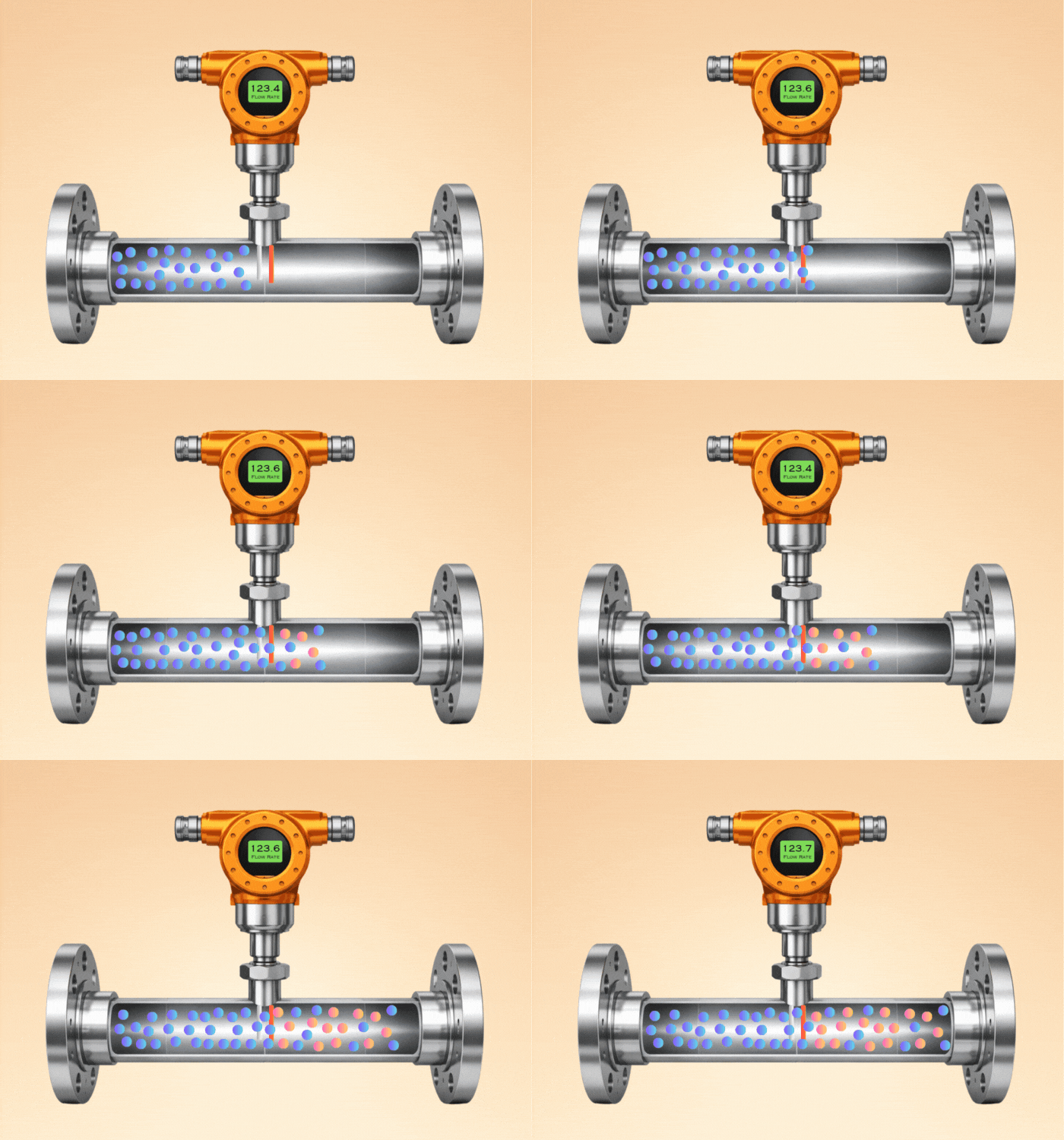
What is a Thermal Mass Flow Switch?
A thermal mass flow switch is an industrial device used to detect the presence, absence, or minimum level of flow in a pipeline and to activate an electrical output when a predefined flow set point is reached. It is commonly used for monitoring, protection, and safety functions rather than for flow measurement.
Unlike a thermal flow meter, it does not provide a continuous flow value, but a simple binary switching signal (ON/OFF), relay, or switching output, which can be used to trigger alarms, start or stop equipment, or initiate safety interlocks.
The device works on the thermal dispersion principle, same as thermal mass flow meter. It contains a heated sensor element and a reference sensor. When there is no or low flow, the heated sensor remains warm, no heat is removed, the switch remains in its default state as the gas or liquid flows past the sensor, it removes heat from the heated element. The sensor temperature drops and the heating power rises. Once the cooling effect exceed the setpoint, the switch changes its state. The rate of heat loss increases with flow velocity, allowing the instrument to determine whether the flow is above or below the preset threshold.
Thermal mass flow switches are available in different design variants to suit a wide range of installation and application requirements. For example, these switches are offered in multiple configurations to accommodate different process conditions, mounting options, and output requirements.
To ensure correct selection based on your process conditions, medium, and installation requirements, it is recommended to review the product specifications or contact us for application support.
Are a Thermal Mass Flow Meter and a Thermal Mass Flow Switch the same, and what is the difference between them?
No. Although thermal mass flow meters and thermal mass flow switches are based on the same thermal dispersion (thermal mass) measurement principle and both use a heated temperature sensor cooled down by the flowing medium they are designed for distinctly different functions.
A thermal mass flow meter is used for continuous and quantitative measurement of gas flow. It measures the actual mass flow rate directly and provides a real time output like an analog signal (e.g. 4-20mA, 0/1-5V) impulse output or digital communication (Modbus RTU) that can be used for process monitoring and control, energy and consumption measurement, leak detection and system optimization ,data logging, and balancing gas flows.
A thermal mass flow switch is used for flow detection rather than measurement. It determines whether flow is present, absent, or above or below a predefined set point. When the flow reaches the configured threshold, the device changes its switching state and sends a relay or digital signal.
| Parameter | Thermal Mass Flow Meter |
Thermal Mass Flow Switch |
| Primary Function | Measures actual mass flow rate | Detects flow presence or threshold |
| Output Type | Continuous analog or digital signal | Switching or relay output |
| Flow Information | Real time mass flow values | No quantitative flow indication |
| Accuracy | High accuracy and repeatability | Not designed for measurement accuracy |
| Set Point | Optional alarms or limits | User defined switching threshold |
| Control Capability | Process monitoring and control | Alarms, safety, and interlocks |
| Application Focus | Measurement, optimization, reporting | Protection and automation logic |
What are the advantages of using a thermal mass flow meter?
Thermal mass flow meters, featuring no moving parts for long service life and low maintenance, low pressure drop, no need for density correction, wide turndown ratio, and suitability for low flow rates as well as large pipe diameters via flexible probe installation and insertion lengths, are ideal for gas flow measurement in many industrial applications, particularly for monitoring low gas flow rates.
In contrast to volume flow meters such as fluid flow meters (rotameters) or turbine gas meters, thermal mass flow meters are less susceptible to temperature and pressure fluctuations during inflow due to the direct mass flow measuring.
Particular advantages of Kobold Thermal Mass measurement devices over those mentioned above:
- High accuracy at low flow rates: Our meters provide accurate and stable readings even for low gas flow velocities that many other technologies struggle to measure.
- Fast response time: An included platinum coated sensor provides fast response time and high accuracy over a wide measuring range.
- Versatility in gas types: Thermal Mass Flow Meter can handle a broad range of gases and gas mixtures (air, oxygen, nitrogen, natural gas, argon, CO₂, etc.), making it a flexible choice for various applications.
- Optional built in features: Some models include useful features like alarm outputs or configurable setpoints. For example, the meter can trigger an alarm or relay when the flow goes above or below a certain threshold, combining flow measurement and flow switching functions.
- Adjustable damping (averaging) and Filter time to reduce noise and fluctuations: Averaging Time (AV Time) looks at the measured values over a short period of time. and shows their average, which can smooths out small, random jumps. The Filter Time defines how fast the output reacts to changes in the input signal. Sudden spikes can softened with a low pass filter, so the output does not react instantly to every small change.
Do thermal mass flow meters require a lot of maintenance?
No. One of the big benefits of thermal mass flow meters is that they are generally low maintenance. Since there are no moving parts in contact with the gas and low mechanical stress on components, there’s very little wear and tear over time. The solid state sensors (RTD`s) and electronics are built for long term stability. In normal operation, you typically won’t need to frequently service or replace parts on a thermal flow meter.
For most applications, maintenance is limited to occasional checks or cleaning of the sensor tip or flow straightener if used. If the gas is dirty (to ensure no buildup on the sensors) it’s also wise to verify calibration periodically (for example, annually) to ensure accuracy, but day to day operation does not require constant upkeep. Overall, they are designed for long term, continuous use with minimal intervention, which is why they’re often chosen as a low maintenance flow meter solution. For guidance on maintenance schedules and best practices for your application, contact KOBOLD.
Can thermal mass flow meters measure liquids, or are they only for gases?
Thermal dispersion mass flow meters can measure both gases and certain liquids, but they are primarily designed for gas flow applications. They excel at measuring clean gases such as air, nitrogen, natural gas, oxygen, argon, carbon dioxide, and many other industrial gases, even at low pressures and low flow rates.
For liquids, thermal flow meters are not typically used for precise measurement because liquids absorb and transfer heat differently than gases. Specialized thermal flow sensors and flow switches exist for monitoring certain liquid flows, such as water or water based liquids, but these are generally used to confirm the presence of flow rather than provide exact flow rates.
For accurate liquid flow measurement, other technologies such as magnetic or ultrasonic flow meters are often preferred. Thermal dispersion meters are most effective when the fluid is clean, stable, and free from particulates or coatings that could affect sensor performance.
What materials are used to make thermal mass flow meter?
Thermal mass flow meters are built using durable materials designed to withstand industrial conditions and ensure long term reliability, mechanical strength and thermal conductivity. Common materials include:
- Stainless Steel (KEC/KEP probe; MAK/MAS housing): Primarily used for sensor probes and flow bodies in industrial grade meters. Stainless steel is strong, corrosion resistant, and suitable for high temperatures and pressures, making it ideal for harsh or corrosive gas applications.
- Brass: Often used for flow bodies or fittings in meters for moderate conditions. Brass offers good corrosion resistance and is cost effective for low to medium pressure applications.
- Engineering Grade Plastics (KET/KEP housing): Materials such as polycarbonate, PPS (Polyphenylene Sulfide), or nylon are used in housings, non wetted parts, or in flow bodies for less demanding applications. These plastics are lightweight, cost efficient, and suitable for clean or low pressure environments.
The choice of material directly impacts the meter’s chemical compatibility, temperature and pressure limits, and durability. Selecting the appropriate construction material ensures optimal performance and prevents corrosion or damage over time. Always verify that the meter’s materials are compatible with the specific gas or liquid in your system.
To know more about material suitability for your application, contact us.
What pressure and temperature ranges can they handle?
Thermal mass flow meters come in various models, and their pressure and temperature limits depend on how they’re built. In general They can handle from around vacuum conditions up to about 6 bar (~90 psi) in basic models, and robust designs can go up to 100 bar or more (~1450 psi). There are even specialized high pressure versions for certain industries. Always check the specified maximum pressure (p_max) for the particular model you’re interested in, as it can vary widely.
Standard thermal dispersion flow meters typically operate up to roughly 50°C (122°F) to 100°C (212°F) without issue. For higher temperatures, there are high temp versions with extended probes or cooling arrangements that can handle process gas temperatures around 150°C to 180°C (302–356°F). Some advanced designs might allow even higher temperatures by distancing electronics from the heat. Again, the maximum temperature (t_max) tolerance is model specific.
Because these limits differ model wise, it is important to review the specific product specifications for your application. If your process involves high pressure or extreme temperatures, ensure you select a thermal flow meter model that is rated for those conditions. The good news is that there are thermal mass flow meters available for a wide range of conditions from low pressure HVAC ducts to high pressure industrial gas lines and from sub zero freezer environments to hot furnace exhaust streams.
To know more about the suitable range for your process, contact our industry expert.
How accurate are thermal mass flow meters or rather calorimetric flow switches?
Thermal dispersion flow meters are well known for providing reliable accuracy in gas flow measurement, although the exact accuracy depends on the meter design, calibration, and application conditions.
Typical accuracy ranges include:
- General accuracy: Most thermal mass flow meters offer accuracy in the range of ±1% to ±5% of full scale (FS). Our KEC/KEP/KET models can achieve an accuracy of ±1.0% of reading and ±0.3% of full scale on request (Higher-performance models).
- Economy or basic models: Lower cost or general purpose designs may specify accuracy closer to ±3–5% of full scale.
- Measurement Accuracy vs. switching Accuracy & repeatability: When used as a flow meter, measurement accuracy is typically specified as a percentage of the measured value (MV) or the full-scale value (FS). In contrast, for flow switches (e.g., KAL-L), which merely detect whether the flow is above or below a setpoint, the switching accuracy indicates how closely the switching point corresponds to the set setpoint typically ±10% of the setpoint, which is sufficient for ON/OFF or alarm applications. It describes the deviation from the set or limit value. Repeatability, also referred to as reproducibility, describes how reliably a switch delivers the same value during repeated measurements or switching operations under identical conditions (e.g., KAL-D). Devices used for process monitoring, laboratory applications, or continuous measurement typically emphasize repeatability, as they must ensure the precision of the ongoing measured value.
It is important to note that the stated accuracy is influenced by proper calibration, gas composition, flow profile, and installation conditions. Many manufacturers specify accuracy as a combined value (±% of reading plus ±% of full scale), so reviewing the product datasheet is essential.
Overall, thermal dispersion flow meters deliver stable, repeatable, and application appropriate accuracy for a wide range of gas flow monitoring and process control applications. To know the suitable accuracy range for your application, get in touch with us
Where are thermal mass flow meters used?
Thermal mass flow meters are used in a wide range of industries - everywhere precise gas measurement is required as an alternative to measurement principles such as differential pressure, Coriolis, or ultrasonic flow measurement. Typical application areas include:
- Compressed Air Systems: Monitoring compressed air usage in factories, detecting leaks, and optimizing compressor operation. For example, they are used in air audits and to measure airflow in distribution lines without causing pressure drop.
- Natural Gas Measurement: Measuring natural gas flow for burners, boilers, heaters, or fuel consumption tracking. Thermal flow meters provide direct mass flow readings for natural gas in industrial plants, commercial boilers, and even some residential gas sub metering.
- Biogas and Flare Gas: Monitoring biogas production (e.g., in digesters at wastewater treatment plants or landfills) and measuring flare gas or waste gas emissions. They handle the low pressure, variable flow nature of biogas well and are useful for environmental compliance (emissions monitoring) and process optimization.
- HVAC and Building Management: Measuring airflow in heating, ventilation, and air conditioning systems. They can monitor ventilation rates, exhaust flows, or airflow in cleanrooms and help in energy management for large facilities.
- Environmental & Emissions Monitoring: Used in stack gas or flue gas measurement for pollution control (when the gas composition is known and compatible). They measure mass flow of exhaust gases in chimneys, incinerators, or processing plant outlets to ensure environmental regulations are met.
- Industrial Process Gases: Controlling and monitoring gases like oxygen, nitrogen, carbon dioxide, argon, hydrogen, etc., in various manufacturing processes. For instance, in chemical and petrochemical plants, thermal meters help regulate gas flow in reactors or packaging. In steel and metal production, they measure gases (like argon purging in steelmaking).
- Semiconductor & Electronics Manufacturing: Maintaining precise flow rates of ultra pure gases (such as silane, ammonia, nitrogen trifluoride, etc.) for processes like CVD, etching, and wafer fabrication. The high sensitivity at low flows is crucial here.
- Food and Beverage Industry: Monitoring CO₂ for carbonation or fermentation (breweries, beverage bottling) and controlling gas flow in packaging or blanketing processes. Also used for gas flow in chillers and freezer systems.
- General Industrial OEM Applications: Thermal mass flow sensors are integrated into machines or systems (like air sampling devices, analytical instruments, or drying systems) where gas flow needs to be measured or controlled reliably.
From large scale industrial facilities to OEM instruments, these meters help improve energy efficiency, process control, and product quality by providing accurate gas flow data.
Does moisture or humidity affect a thermal mass flow meter?
Moisture can affect the performance of a thermal mass flow meter, so it is an important consideration in gas flow applications.
- Humidity (water vapor in the gas): A small amount of moisture vapor, such as normal humidity in air or process gases, usually has only a minor effect on the measurement. In most cases, the impact is negligible, especially when the humidity level remains stable. A slight increase in humidity may cause a small positive bias in the measured flow because water vapor transfers heat differently than dry gas.
- Liquid moisture or condensation: The presence of liquid water droplets or condensation can significantly affect accuracy and should be avoided. Liquid water absorbs much more heat than gas, which can cause the meter to indicate a higher flow rate than is actually present. This may lead to unstable or inaccurate readings. If moisture accumulates on the sensor, performance may be affected until the sensor dries completely.
- Practical considerations: Thermal mass flow meters perform best with clean, dry gases. In applications involving humid gas, it is recommended to keep the gas temperature above the dew point to prevent condensation, or to use upstream moisture separators or filters. While some advanced thermal flow meters can compensate for humidity to a limited extent, supplying dry gas ensures the most accurate and stable measurement.
Will changes in gas composition affect the meter’s readings?
Yes, changes in gas composition can affect the accuracy of a thermal mass flow meter. These meters are typically calibrated for a specific gas or a defined gas mixture because different gases have different thermal properties, such as specific heat and thermal conductivity. If the gas composition changes from the calibration condition, the measurement accuracy can be impacted.
The extent of this impact depends mainly on how much the actual gas composition deviates from the calibration gas, as outlined in the following cases:
- Calibration specific to the gas: For example, if a thermal mass flow meter is calibrated for 100% nitrogen and is later used to measure a nitrogen–helium mixture or a gas containing CO₂, the readings may be inaccurate. This is because helium and CO₂ transfer heat differently compared to nitrogen, affecting the heat dissipation used for measurement.
- Minor composition variations: If the change in gas composition is small such as air with trace gases or natural gas with slight composition variations the effect on accuracy is usually limited. In many practical applications, minor changes may introduce only a small measurement error rather than making the reading unusable.
- Significant composition changes: When the meter is used for significantly different gases or varying mixtures, recalibration is recommended. Alternatively, correction factors may be applied if supported by the device. Some thermal mass flow meters allow users to input gas correction factors or store multiple gas calibrations.
In summary, thermal mass flow meters rely on assumed gas properties for mass flow calculation. When these properties change, measurement deviations can occur. For applications involving variable gas mixtures, such as biogas with changing methane and CO₂ content, users should be aware of potential accuracy shifts and ensure appropriate calibration or correction methods are applied.
Consequently, the gas type and its exact composition should always be specified in detail when making an inquiry.
Are there any special installation requirements for thermal mass flow meter?
Thermal mass flow meters are generally easy to install, but following a few best practice guidelines helps ensure accurate and stable measurements:
- Straight pipe requirements: The meter should be installed in a straight section of pipe away from flow disturbances. Typically, a straight run of 5–10 pipe diameters upstream is recommended, with additional length if there are nearby elbows, valves, or reducers. A short straight run downstream is also advisable. This allows a stable and fully developed flow profile at the sensor.
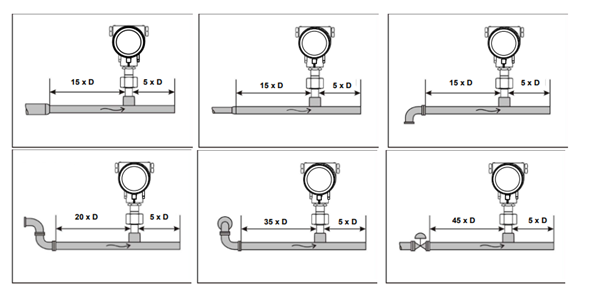
- Insertion depth and alignment: For insertion-type meters (such as KEC/KEP-1/3), the probe must be inserted to the correct depth - usually near the centre of the pipe and aligned according to the flow direction markings or manufacturer instructions. Incorrect positioning can affect measurement accuracy.
- Vibration and mechanical stress: The flow meter should be installed safely and in a proper, professional manner to minimize vibration. Excessive mechanical stress or pulsating flow from nearby equipment can negatively affect performance and long-term reliability..
- Electrical installation: Power and signal wiring should follow the manufacturer’s recommendations. Proper grounding and shielding may be required to prevent electrical noise from interfering with the measurement signal.
- Environmental considerations: While the sensor is designed to handle process conditions, the transmitter or electronics should be installed within the specified ambient temperature and moisture limits unless specifically rated for harsh environments.
Manufacturers typically provide detailed installation guidelines, including recommended straight pipe lengths for different upstream disturbances. Adhering to these recommendations helps achieve optimal accuracy and reliable operation. Compared to some other flow measurement technologies, thermal mass flow meters generally do not require impulse lines or complex piping arrangements.
What are the operating conditions of thermal mass flow meters?
Thermal mass flow meters are widely used and reliable in many gas applications, but they do have certain limitations that should be considered when selecting and applying them:
- Clean, non abrasive gases only: These meters are best suited for clean gases. Dust, dirt, or particulate matter can coat the sensor and affect accuracy or long term stability. Filtration may be required for contaminated gas streams.
- Sensitivity to liquid moisture: While small amounts of water vapor typically have minimal impact, the presence of liquid droplets, mist, or condensation can significantly affect accuracy and may lead to false high readings or sensor damage. Applications should ensure the gas remains above its dew point.
- Dependence on gas properties: Thermal mass flow meters are calibrated for a specific gas or known gas mixture. Changes in gas composition can introduce measurement errors unless correction factors or recalibration are applied.
- Primarily for gas measurement: These meters are mainly designed for gas flow measurement. Special sensors exist for aqueous media, but these are usually suitable only for flow detection rather than precise measurement (e.g., KAL-K).
- Temperature and process limits: Standard thermal mass flow meters operate within defined temperature ranges. For very high or very low-temperatures, such as in extremely cold(cryogenic), special designs or alternative measurement methods are required.
- Initial cost: The upfront cost is typically higher than simpler devices such as orifice plates or variable area flow meters, though maintenance requirements are generally low.
- Temperature limitations: Standard models operate within defined temperature ranges. Very high temperature or cryogenic applications may require specialized designs or alternative technologies.
- Pressure drops: Insertion type meters introduce negligible pressure loss. In line thermal flow meters should be properly sized to avoid unintended flow restriction.
In summary, thermal mass flow meters are best suited for applications involving clean, dry gases with known and stable composition, operating within the specified process and environmental limits. Under deviating conditions, gas treatment (e.g., drying, filtration) or alternative flow measurement technologies should be considered.
Are there models with ATEX or explosion proof certification?
Yes, many manufacturers offer thermal dispersion mass flow meters that are certified for use in hazardous or explosive environments. These models are designed for areas where flammable gases, vapours, or dust may be present, such as chemical plants, oil and gas facilities, and certain industrial sites.
Common certifications and approvals include:
- ATEX (EU): Confirms suitability for explosive atmospheres in Europe. ATEX certified meters carry markings such as Ex d (flameproof within a robust enclosure),or Ex ia (intrinsic safety that limits energy to prevent ignition), along with the applicable gas or dust group and temperature class.
- IECEx: An internationally recognized certification system for equipment used in explosive atmospheres, similar in scope to ATEX.
- FM/FMc/ CSA (North America): Approvals for hazardous locations in the United States and Canada, typically classified as Class I-III, Division 1 or 2, depending on the risk level. Unlike ATEX/IECEx (Zones), North America traditionally uses the Class / Division system.
- UL (Underwriters Laboratories): UL is one of the most established U.S. Nationally Recognized Testing Laboratories (NRTLs) and verifies that electrical and electronic equipment can be safely installed and operated without creating fire, explosion, or electric shock hazards.
Not all thermal mass flow meters carry hazardous area approvals, as many applications do not require them. Therefore, it is important to specify certification requirements during selection. Certified models will clearly list approvals in their technical documentation, along with the applicable zones or divisions.
In summary, thermal mass flow meters with ATEX, IECEx, or FM/CSA approvals are available, but certification depends on the specific model. Always verify the exact classification in the datasheet to ensure it matches your site conditions, and consult the manufacturer or distributor if guidance is needed.
Do thermal mass flow meters need to be calibrated regularly?
Thermal mass flow meters, like most precision measurement instruments, require periodic calibration to maintain long term accuracy. However, they are typically factory calibrated for the specified gas and measurement range before delivery.
Once installed, the calibration frequency depends on application criticality and operating conditions:
- Factory calibration: Manufacturers calibrate thermal mass flow meters across multiple flow points, often using air or the specified process gas. This establishes a reliable baseline and is usually sufficient for extended operation in many standard applications.
- Recommended recalibration interval: As a general guideline, recalibration or at least calibration verification is recommended once per year. In non critical applications, and where previous calibrations show minimal drift, this interval may be extended to up to two years.
- Critical applications: For applications requiring high accuracy such as regulatory compliance, custody transfer, or tight process control more frequent calibration (every 6 to 12 months) is advisable.
- Operational stability: Thermal mass flow meters are known for good long term stability. When used with clean gases and in stable environmental conditions, calibration drift is typically low. Exposure to contaminants, extreme temperatures, vibration, or sensor fouling can increase drift and shorten recalibration intervals.
- Calibration process: Calibration is normally performed by comparing the meter’s output against a traceable reference standard in a calibration laboratory or test facility. While some meters offer diagnostic or verification features, full calibration generally requires specialized equipment.
Periodic calibration is a best practice to ensure continued measurement accuracy. A yearly calibration check is commonly accepted across industries, but the exact interval should follow the manufacturer’s recommendations and the demands of the specific application. To learn more about our flow measurement solutions, visit us and for calibration support or technical assistance, feel free to Contact Us.